Product Description
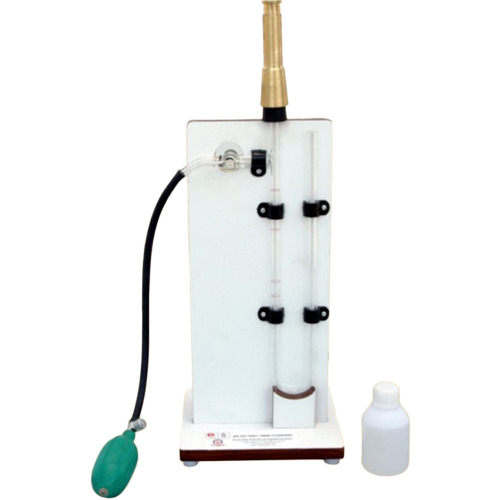
IS 4031,5516, 1727 & 4828, ASTM C-204 BS 4359-2 The apparatus is used for determining the fineness of cement in terms of specific surface expressed as total surface area in square centimeters per gram of cement. This is a variable flow type are permeability.
Specification: The apparatus consists one each of permeability cell 12.5mm I.D. manometer 'U' type mounted on stand with a built in stop cock, perforated disc, plunger rubber stopper, rubber tube 30cm long. Packet of 12 filter paper disc and a bottle of 100ml dibutylphthalate liquid.
Key Principle and ApplicationThis apparatus operates on the Blaine air permeability method, which assesses the fineness of cement by calculating its specific surface area. Commonly used in labs for quality control, it ensures cement and similar powders meet standardized fineness specifications critical for consistent construction materials.
Robust Construction and Included AccessoriesBuilt with corrosion-resistant metal and premium glass components, the device comes supplied in sturdy packing. Accessories such as the permeability cell, aspirator bulb, filter paper, manometer fluid, cleaning tools, and a calibration certificate are included for accurate, hassle-free operation.
Simple and Accurate Manual OperationNo power source is needed for this apparatus, as it is mechanically operated and provides results through a glass manometer. The entire process typically takes 2-5 minutes and requires a single specimen of 2.5-3 g, making it convenient and efficient for routine cement fineness analysis.
FAQ's of Blaine's Air Permeability Apparatus:
Q: How does the Blaines Air Permeability Apparatus determine cement fineness?
A: The apparatus calculates fineness by measuring the specific surface area of cement using air permeability. Ambient air passes through a bed of prepared cement in a permeable cell, and the drop in air pressure is read on the glass manometer, allowing determination of the Blaine value.
Q: What is the typical procedure for conducting a test with this apparatus?
A: Place approximately 2.5 to 3 g of cement into the permeability cell, assemble the unit as per instructions, add the non-toxic manometer fluid, and use the aspirator bulb to pass air through the specimen. The pressure drop is measured on the manometer, from which cement fineness is calculated.
Q: When should the Blaines Air Permeability Apparatus be used in a laboratory?
A: It should be used whenever cement or similar powder samples need their fineness checked for quality control or compliance with standards such as IS: 4031, ASTM C204, or EN 196-6, typically during laboratory testing before construction applications.
Q: Where is this apparatus most commonly used?
A: The device is utilized in materials testing laboratories, quality control labs at cement plants, universities, research institutions, and anywhere there is a need to validate the fineness of cementitious materials.
Q: What are the key benefits of using a manually operated version of this apparatus?
A: Key advantages include ease of use, reliable results without the need for electricity, excellent portability, low maintenance, and suitability for use in a variety of laboratory settings under standard temperature and humidity conditions.
Q: What is included in the packing of the Blaines Air Permeability Apparatus?
A: The apparatus is packed securely for safe transport and comes complete with a permeability cell, glass manometer, rubber aspirator bulb, filter paper, non-toxic manometer fluid, cleaning accessories, and a calibration certificate.
Q: How accurate and reproducible are the results using this apparatus?
A: The device delivers results with an accuracy of within 1% of the reading and a resolution up to 10 cm2/g, provided the standard procedure is followed and all components are properly maintained and calibrated.
 We'are open : Mon - Sat 9:00 - 18:00





 Send Inquiry
 Send Inquiry