About Compaction Factor Apparatus
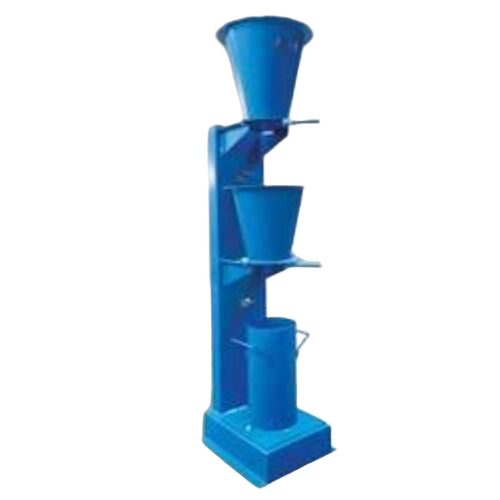
The apparatus is used for determining the work ability of fresh concrete, provided the maximum size of the aggregate does not exceed 38mm. The test is particularly useful for concrete mixes of very low work ability where true slump values are not reliable.
Specifications: It consists of two rigid conical hoppers and a cylinder mounted on a rigid metal frame. The lower openings of the hoppers are fitted with hinged trapdoors having quich release catches. A circular metal plate is provided to cover the top of the cylinder. Supplied complete with one plasterer's trowel and one tamping rod, 16mm diax600 mm long, one end rounded.
Reliable Concrete Workability TestingEngineered for versatility, the Compaction Factor Apparatus guarantees accurate and repeatable assessment of concrete's workability in both laboratory and field settings. Its sturdy construction resists corrosion, and the quick setup process minimizes preparation time. The dual conical hopper configuration ensures smooth flow and precise measurement for various concrete types. Whether for low, medium, or high workability mixes, this apparatus delivers dependable results.
Effortless Operation & PortabilityThis compact and portable apparatus (dimensions: 430 x 150 x 450 mm, weight: approx. 18 kg) enables quick relocation between testing sites. Designed for simple, manual operation-no power is needed-users can assemble and disassemble the unit rapidly. With accessories like a tamping rod and cleaning brush included, the process is streamlined for efficient testing and maintenance.
FAQ's of Compaction Factor Apparatus:
Q: How is the Compaction Factor Apparatus used to test concrete workability?
A: The apparatus tests workability by allowing concrete to fall through two vertically aligned conical hoppers into a collection cylinder. The difference in volume between partially and fully compacted concrete indicates the workability, calculated as the compaction factor.
Q: What accessories are supplied with the apparatus?
A: Supplied accessories include a tamping rod, a cleaning brush for maintenance, and an optional weighing balance for enhanced measurement accuracy during concrete sample preparation.
Q: When and where should I use the Compaction Factor Apparatus?
A: The apparatus is suitable for both laboratory and field settings. Use it during quality control or research when you need to determine the workability of fresh concrete mixes, especially for low, medium, or high workability types.
Q: What is the process for conducting a compaction factor test?
A: Fill the top hopper with a concrete sample. Remove the hopper doors sequentially, allowing the concrete to drop into the lower hopper and finally into the collection cylinder. Weigh the partially and fully compacted concrete to compute the compaction factor.
Q: What are the benefits of using this apparatus in concrete testing?
A: Benefits include robust and corrosion-resistant construction, quick manual assembly, portability, accurate measurements (within 1%), and suitability for various concrete workability ranges. It facilitates reliable quality control during concrete production.
Q: What volume and size of concrete specimen can the apparatus handle?
A: The collection cylinder has a 1-liter volume, and the apparatus can accommodate approximately 6 liters of concrete per specimen for each test.
Q: Is the apparatus suitable for use in extreme environments?
A: Yes, it functions effectively at ambient temperatures up to 50C and under standard laboratory or field humidity conditions. Its metallic body and powder coated/painted finish provide durability for rugged environments.
 We'are open : Mon - Sat 9:00 - 18:00





 Send Inquiry

 Send Inquiry
 Send Inquiry